Evaluation of flow-dependent frog objectives and targets
Technical report supporting the NSW Basin Plan Matter 8 Reporting 2019 to 2024
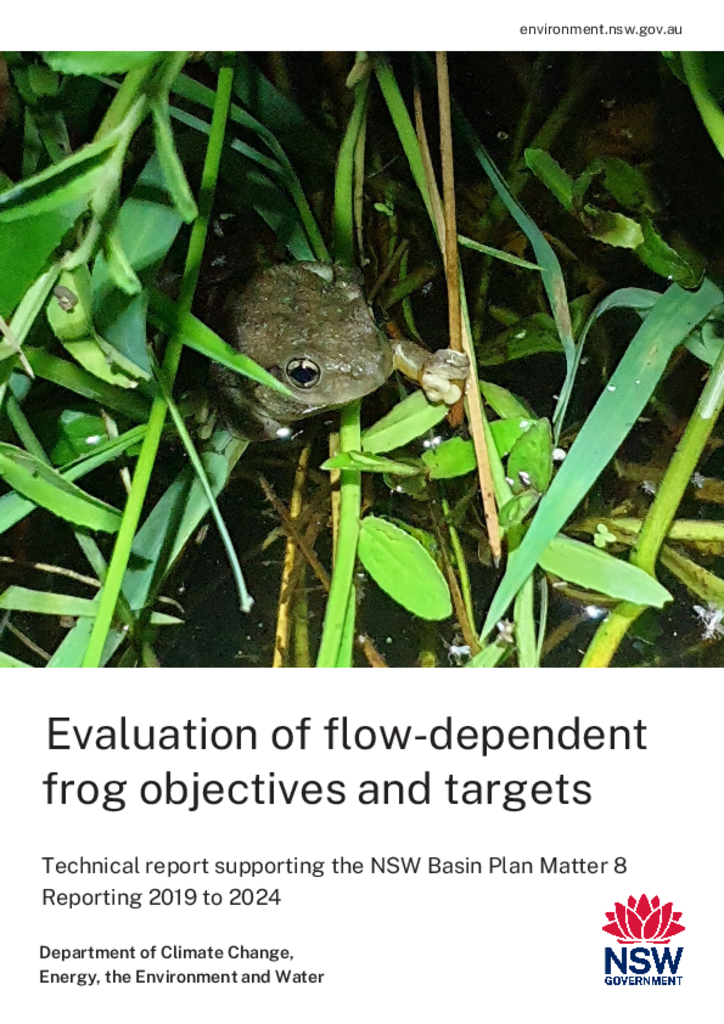
The NSW Department of Climate Change, Energy, the Environment and Water monitors the health of wetlands in the Murray–Darling Basin, including outcomes from environmental water deliveries. Nearly half of the frog species residing in floodplain wetlands of the Murray–Darling Basin breed in response to river flows that inundate wetlands and therefore benefit from the delivery of environmental water. These ‘flow-dependent’ species are the primary focus of the department’s Water for the Environment Frog Monitoring Project.
Publisher: Department of Climate Change, Energy, the Environment and Water
Cost: Free
Language: English
ISBN: ISBN 978-1-923436-77-0 / ID: EH20250158
File: PDF 4.76 MB / Pages 0
Name: evaluation-of-flow-dependent-frog-objectives-and-targets-250158_0.pdf
The project objectives are to monitor the response of frogs to wetland inundation by assessing species richness, distribution, relative abundance and breeding activity (including calling activity), and the presence of tadpoles and/or metamorphs (juvenile frogs). Progress towards meeting long-term objectives and targets for flow-dependent frog species was assessed in the Gwydir Wetland system (Gwydir Wetlands), Macquarie Marshes and lower Murrumbidgee (Lowbidgee) floodplain, which contain nationally and internationally significant floodplain wetlands in the NSW Murray–Darling Basin.