The NSW Government has invested more than $20.5 million to deliver the most comprehensive population estimate of koalas in New South Wales and improve our understanding of:
- distribution – where koalas are found within their geographic range
- occupancy – the likelihood of koalas living in a certain area
- abundance – the estimated number of individual koalas in an area.
Scale of the koala baseline survey
- More than $20.5 million invested
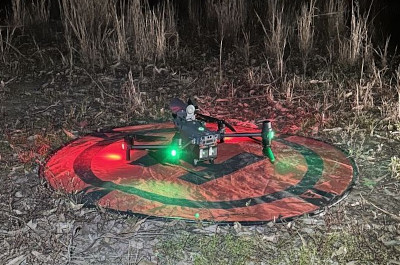
- Over 6,500 km flown by drone, the equivalent of flying from Sydney to Perth and back
- Over 1,000 sites surveyed across national parks, state forests and private properties
- Over 400,000 hours of acoustic recordings
Baseline survey reports
Survey methods
More than 1,000 locations in national parks, state forests and private properties were surveyed using advanced monitoring methods, including heat-detecting drones and passive acoustic recorders. Over 2,500 additional sites from other NSW Koala Strategy programs were also used in the modelling to further improve the accuracy and precision of the baseline models, putting the total input sites at over 3,500.
Over 14 nights during the spring breeding season, passive acoustic recorders were deployed at sites where koalas are known to range, to record male vocalisations. At a subset of these sites, drone surveys were conducted at night to count the number of koalas present.
Technological advances in monitoring methods, particularly drones, have enabled scientists to survey areas that were previously difficult to access, and can detect more koalas, with greater accuracy than ever before.
Key findings
Results from the koala baseline survey estimate that there are 274,000 koalas in New South Wales, with a 95% confidence interval of 231,000 to 320,000 koalas.
Data collected from drone surveys and passive acoustic recorders was modelled with environmental factors like food tree species, rainfall, temperature, tree height and soil nitrogen to calculate the population estimate.
Two mathematical models were used to understand koala abundance and occupancy in New South Wales. Modelling showed:
- koalas are more likely to occupy areas with healthy feed trees, consistent temperatures and low windspeed
- higher numbers of koalas are likely to be found in areas with taller feed trees and higher soil nitrogen
- koalas are less likely to be found in areas far from waterways or in arid areas.
The distribution of koalas in New South Wales is concentrated along the coast and nearby ranges, especially in the north-east, while inland populations are fragmented across small habitat patches.
Protecting koalas for the future
Results from the koala baseline survey provide a strong foundation to track population changes over time and guide conservation actions, but this does not change the need for protection and management.
Koalas still face significant threats, including habitat loss, fragmentation and degradation, climate change, disease, declining genetic diversity, vehicle strike, bushfire, and dog attack.
While establishing a baseline population is critical, it is also essential to examine long-term population trends to fully understand the status and dynamics of koala populations in New South Wales.