This comprises 24 biodiversity stewardship sites and one National Parks and Wildlife Service reserve.
Formerly referred to as biobanking, Biodiversity Stewardship Agreement sites are funded by the Growth Centres Biodiversity Offset Program to protect and provide ongoing management to restore ecological values and ensure the site’s long-term conservation.
Offset locations
The map below shows the locations of land protected by the offset program (sites 1 to 25).
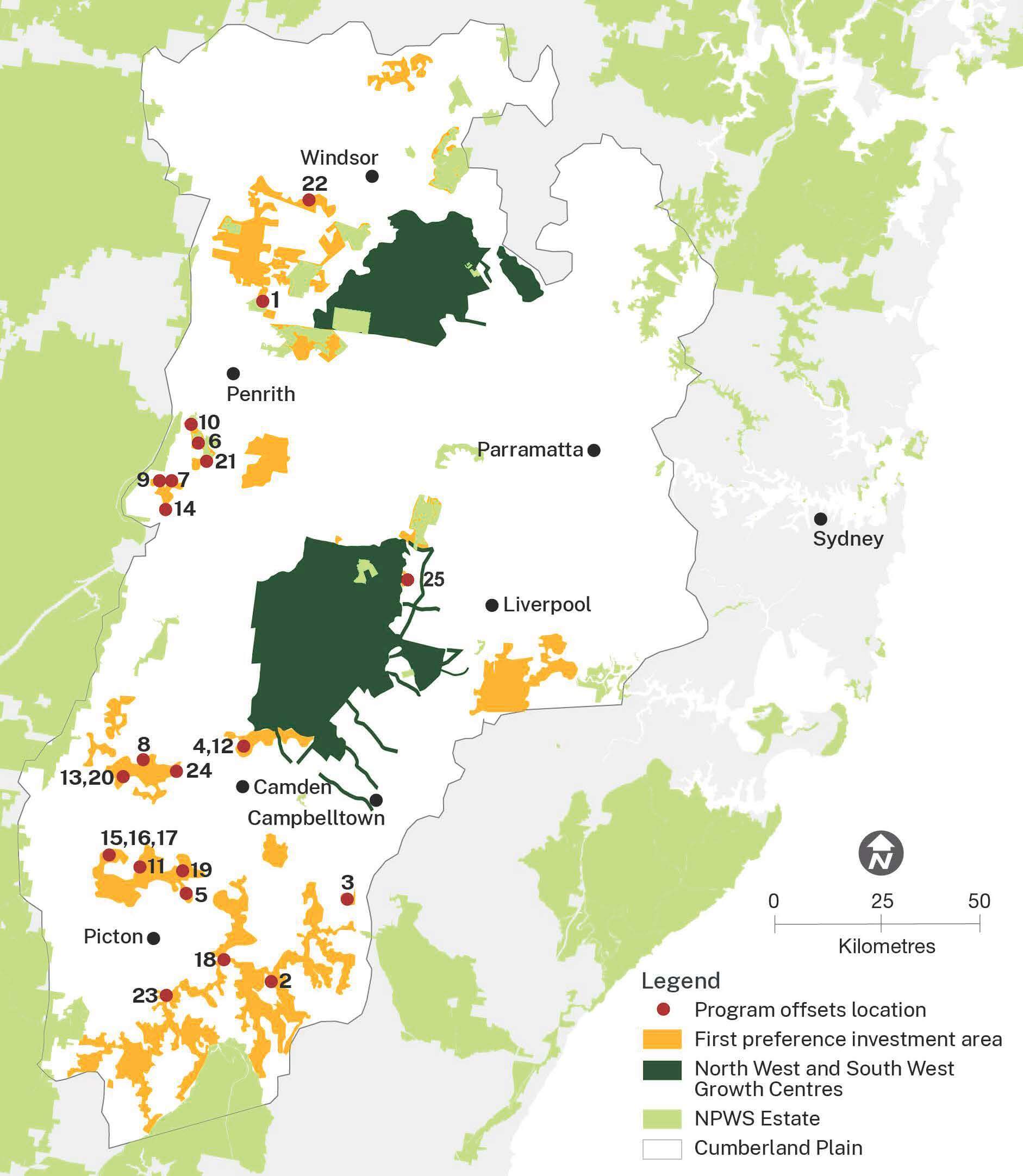
In 2009, the offset program purchased Wianamatta Nature Reserve, in Cranebrook, Penrith local government area, with the additional support from an $11.7 million Australian Government grant.
The 181-hectare reserve protects 161 hectares of threatened ecological communities, including:
- Castlereagh Swamp Woodland
- Cooks River Castlereagh Ironbark Forest
- Castlereagh Scribbly Gum Woodland
- Shale Gravel Transition Forest.
This large, connected landscape offers vital refuge for native plants and animals and is not counted towards offset requirements under the Sydney Growth Centres Strategic Assessment Program.
The reserve is home to many threatened species, such as:
- Bynoe's wattle (Acacia bynoeana)
- Allocasuarina glareicola
- Dillwynia tenuifolia
- Grevillea juniperina subsp. juniperina
- Micromyrtus minutiflora
- nodding geebung (Persoonia nutans)
- Sydney bush-pea (Pultenaea parviflora)
- eastern free-tail bat (Mormopterus norfolkensis)
- Cumberland Plain land snail (Meridolum corneovirens).
Before its protection, the site suffered from illegal access and dumping. In 2010, the offset program funded fencing along road frontages to stop further damage to vegetation and support the reserve’s ecological recovery.
In 2010, the first biobank site was established at the historic St Mary’s Towers property at Douglas Park, in the Wollondilly local government area. The biobank site (BA40) conserves the natural transition between shale woodlands and sandstone gully forests in the southern Cumberland Plain.
The offset program funded the long-term conservation of 36 hectares of critically endangered Cumberland Plain Woodland, 33 hectares of Sandstone Transition Forest, and 11 hectares of gully forest and dry rainforest by purchasing and retiring biodiversity credits and funding ongoing ecological management.
Beulah is a 90-hectare historic property near Appin, in the Wollondilly local government area, home to the original 1830s residence of explorer Hamilton Hume. The site holds outstanding biodiversity values and conserves 20 hectares of critically endangered Cumberland Plain Woodland, 40 hectares of Shale Sandstone Transition Forest, and known koala habitat.
In 2010, the offset program helped the Historic Houses Trust of NSW to purchase the property by contributing $600,000 and securing a biobanking agreement to permanently protect its remnant vegetation. The biobank site (BA58), created in 2011, conserves 60 hectares of threatened bushland. The offset program purchased and retired biodiversity credits, with proceeds placed in a trust fund to support ongoing ecological management.
The Mater Dei property in Cobbitty, in the Camden local government area, owned by the Sisters of the Good Samaritan since 1910, is celebrated for its heritage and environmental significance. In 2012, a biobank site (BA81) was established to permanently protect 26 hectares of threatened woodland, including the critically endangered Cumberland Plain Woodland surrounding the historic Wivenhoe house.
The site was grazed by livestock and heavily infested with African olive. The offset program funded the long-term conservation of 20 hectares of Cumberland Plain Woodland and 6 hectares of River Flat Eucalypt Forest by purchasing and retiring biodiversity credits to protect and restore ecological values.
Established in 2013, the Mount Hercules biobank site in the Wollondilly local government area permanently protects 22 hectares of high-value bushland at Razorback Range. The offset program funded the long-term conservation of 19 hectares of critically endangered Cumberland Plain Woodland, 2 hectares of Western Sydney Dry Rainforest, and one hectare of Moist Shale Woodland by purchasing and retiring biodiversity credits. The site also provides habitat for the endangered Cumberland Plain land snail (Meridolum corneovirens).
Although much of the bushland is in poor condition and heavily infested with African olive, the offset program funds weed control and ecological monitoring and reporting to restore the site’s ecological values.
The privately owned Mulgoa biobank site (BA99) in the Penrith local government area borders Mulgoa Nature Reserve and showcases how private land conservation can strengthen public reserves, especially in areas where native vegetation is scarce. The site connects with Mulgoa Creek and the Blue Mountains National Park, creating vital habitat corridors for woodland birds, including the threatened varied sittella (Daphoenositta chrysoptera) and black-chinned honeyeater (Melithreptus gularis gularis).
The offset program funded the long-term conservation of 38 hectares of critically endangered Cumberland Plain Woodland, 5 hectares of River Flat Eucalypt Forest, and 7 hectares of Moist Shale Woodland by purchasing and retiring biodiversity credits. This site expands suitable habitat and supports the long-term survival of threatened species in the region.
Fernhill Estate is a 648-hectare privately-owned property in Mulgoa, in the Penrith local government area. The estate contains an 1840s homestead and is listed as ‘historic landscape' in the State Heritage Register. Consistent with the property’s heritage values, large areas of remnant bushland on the property have been protected through biobanking agreements.
The Fernhill East biobank site (BA117) was the first site to protect 128 hectares of bushland in the eastern part of the property. In 2014, the Growth Centres Biodiversity Offset Program funded the long-term conservation of 16 hectares of critically endangered Cumberland Plain Woodland on the site by purchasing and retiring biodiversity credits.
The Orangeville biobank site (BA110) is on a 125-hectare private property used for livestock grazing, in the Wollondilly local government area. In 2012, a 38-hectare biobank site was established along Wattle Creek. The offset program funded the long-term conservation of 9 hectares of critically endangered Cumberland Plain Woodland, 4 hectares of Shale Sandstone Transition Forest, 15 hectares of Sydney Turpentine Ironbark Forest, and 10 hectares of Grey Myrtle Dry Rainforest by purchasing and retiring biodiversity credits.
While the site supports valuable native vegetation, much of it is overrun by African olive. With program funding, intensive bush regeneration is underway to restore the ecological values of this important habitat.
The Fernhill Central West biobank site (BA117) is the second biobank established on the Fernhill property in Mulgoa, in the Penrith local government area. Created in 2014, the 147-hectare site protects a diverse mix of woodlands and forests and provides habitat for threatened birds like the varied sittella (Daphoenositta chrysoptera) and glossy black-cockatoo (Calyptorhynchus lathami lathami).
Between 2013–14 and 2014–15, the offset program funded the long-term conservation of 9.5 hectares of critically endangered Shale Sandstone Transition Forest by purchasing and retiring biodiversity credits. Program funding is restoring the site by removing rubbish, installing fences to keep out livestock, and controlling weeds and feral animals.
The Glenmore Park biobank site (BA137) was established independently of the offset program on a 15-hectare rural residential property in the Penrith local government area. The offset program funded the long-term conservation of 8 hectares of critically endangered Cumberland Plain Woodland, 5 hectares of endangered River Flat Eucalypt Forest, and 2 hectares of endangered Moist Shale Woodland by purchasing and retiring biodiversity credits.
This privately protected site plays a vital role in supporting public reserves. It links 2 separated parts of Mulgoa Nature Reserve, boosting habitat connectivity and long-term viability for native species. Together with the nearby Mulgoa biobank site number 6, it expands the protected bushland by 30% to 276 hectares and strengthens a key biodiversity corridor along Mulgoa Creek, connecting to the Blue Mountains National Park.
Williamswood is a 124-hectare rural property in Mount Hunter, in the Wollondilly local government area. In 2015, a biobank site (BA147) was established independently of the offset program to protect 104 hectares of threatened bushland.
Over 3 years, the offset program funded the long-term conservation of 60 hectares of critically endangered Cumberland Plain Woodland and 4 hectares of endangered Moist Shale Woodland by purchasing and retiring biodiversity credits. Program funding will actively manage weed infested areas to restore the site’s ecological values.
In 2015, a 58-hectare biobank site (BA217) at the historic Mater Dei property was established in Cobbitty, in the Camden local government area. Nestled along the Nepean River, the site sits beside an earlier 26-hectare biobank (Matter Dei site number 4) area protected by the offset program in 2011–12.
The offset program funded the long-term conservation of 34 hectares of critically endangered Cumberland Plain Woodland and 24 hectares of endangered River Flat Eucalypt Forest by purchasing and retiring biodiversity credits. The Stage 2 site also safeguards several rare Camden white gums (Eucalyptus benthamii), helping to conserve important habitat.
A baseline fauna survey conducted in 2016 recorded 137 native species on the property, highlighting its rich biodiversity. Among these were 6 threatened bird species:
- powerful owl (Ninox strenua)
- little lorikeet (Parvipsitta pusilla)
- speckled warbler (Pyrrholaemus sagittatus)
- little eagle (Hieraaetus morphnoides)
- dusky woodswallow (Artamus cyanopterus cyanopterus)
- varied sittella (Daphoenositta chrysoptera).
Three threatened microbat species were also recorded:
- eastern bent-wing bat (Miniopterus orianae oceanensis)
- east coast free-tail bat (Mormopterus norfolkensis)
- large-eared pied bat (Chalinolobus dwyeri).
The survey also confirmed the presence of the threatened Cumberland Plain land snail (Meridolum corneovirens).
The program funded the long-term conservation of 27 hectares of critically endangered Cumberland Plain Woodland by purchasing and retiring biodiversity credits at the Hardwicke Stage 1 biobank site (BA168), in the Wollondilly local government area. The 57-hectare site at Orangeville site number 8 was created independently of the program in 2017.
The site’s vegetation ranges from degraded grasslands to thriving Cumberland Plain Woodland. Since the late 1990s, reduced pastural stock and grazing pressure have enabled natural regeneration to occur across the site. While invasive weeds like African olive, African boxthorn and lantana remain a challenge, secure biobanking funds will support ongoing management and restoration.
The offset program funded the long-term conservation of 3 hectares of critically endangered Cumberland Plain Woodland and 8 hectares of critically endangered Shale Sandstone Transition Forest by purchasing and retiring biodiversity credits on a 20-hectare biodiversity stewardship site (BA339) on a historic property at Mulgoa, in the Penrith local government area.
The offset program funded the long-term conservation of 3 hectares of critically endangered Cumberland Plain Woodland by purchasing and retiring biodiversity credits at a 64-hectare biodiversity stewardship site (BA235) at The Oaks, in the Wollondilly local government area.
Over 2 years, the offset program funded the long-term conservation of 14 hectares of critically endangered Cumberland Plain Woodland by purchasing and retiring biodiversity credits at a 35-hectare biodiversity stewardship site (BA399) at The Oaks, in the Wollondilly local government area.
The offset program funded the long-term conservation of 11 hectares of critically endangered Cumberland Plain Woodland by purchasing and retiring biodiversity credits at a 31-hectare biodiversity stewardship site (BA358) at The Oaks, in the Wollondilly local government area.
The offset program funded the long-term conservation of 18 hectares of critically endangered Cumberland Plain Woodland by purchasing and retiring biodiversity credits at a 67-hectare biodiversity stewardship site (BA382) that adjoins the banks of the Nepean River near Douglas Park, in the Wollondilly local government area.
Over 2 years, the offset program funded the long-term conservation of 19 hectares of critically endangered Cumberland Plain Woodland by purchasing and retiring biodiversity credits at a 101-hectare biodiversity stewardship site (BA250) at Razorback, in the Wollondilly local government area.
The offset program funded the long-term conservation of 15 hectares of critically endangered Cumberland Plain Woodland and a population of the threatened plant spiked rice-flower (Pimelea spicata) by purchasing and retiring biodiversity credits at a 169-hectare biodiversity stewardship site (BA213) at Orangeville, in the Wollondilly local government area.
Over 2 years, the offset program funded the long-term conservation of 41 hectares of critically endangered Cumberland Plain Woodland by purchasing and retiring biodiversity credits at a 59-hectare biodiversity stewardship site (BA 283) in Mulgoa, in the Penrith local government area.
The offset program funded the long-term conservation of 34 hectares of endangered Shale Gravel Transition Forest and 22 hectares of critically endangered Cumberland Plain Woodland by purchasing and retiring biodiversity credits at a 117-hectare biodiversity stewardship site (BS0032) established by the offset program at the Hawkesbury campus of Western Sydney University, in the Hawkesbury local government area.
Over 2 years, the offset program funded the long-term conservation of 44 hectares of Shale Sandstone Transition Forest by purchasing and retiring biodiversity credits at a 144-hectare stewardship site (BS0027) near Picton, in the Wollondilly local government area.
The offset program funded the long-term conservation of 45 hectares of critically endangered Cumberland Plain Woodland by purchasing and retiring biodiversity credits at a 165-hectare biodiversity stewardship site (BS0088) at Brownlow Hill, in the Wollondilly local government area.
The offset program funded the long-term conservation of 11 hectares of critically endangered Cumberland Plain Woodland by purchasing and retiring biodiversity credits at the 91-hectare biodiversity stewardship site (BS0111) in Middleton Grange, in the Liverpool local government area.