The NSW Government, through the National Parks and Wildlife Service, has committed $2.8 million from 2022 to 2024 to implement a rapid response delivery project to help curb wombat mange and research the effectiveness of treatments for the condition.
The program will combat mange in 2 ways. National Parks and Wildlife Service will partner with the Foundation for National Parks and Wildlife to provide targeted funding of up to $2 million to the NSW volunteer wildlife rehabilitation sector and Aboriginal community organisations to purchase and use the approved chemicals and equipment needed to treat mange in free-living wombats. We will also provide $500,000 in grants to research institutions to investigate the prevalence and distribution of mange in New South Wales and the effectiveness of mange control methods.
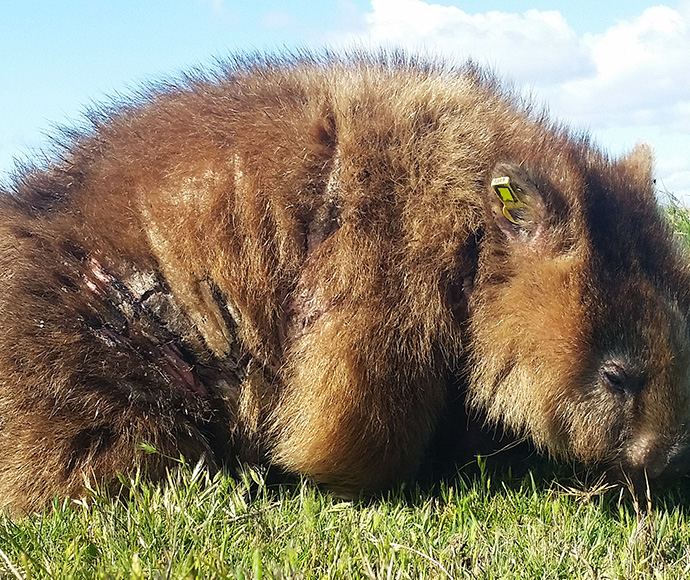
Sarcoptic mange is the most frequently observed debilitating disease condition in bare-nosed wombats, the most common wombat found in New South Wales. More than 10,000 wombats were rescued in New South Wales between 2013 and 2021, and approximately 7% of these (694) were reported as rescued due to mange. It is a disease that occurs across the range of wombats and has significant animal welfare impacts.
Curb wombat mange treatment grants
Grants were available to licensed NSW wildlife rehabilitation providers and Aboriginal community organisations to help cover the direct costs of treating mange in wombats. The type of costs that the grants will cover include:
- purchasing the approved Australian Pesticides and Veterinary Medicines Authority (APVMA) chemicals required to treat affected wombats. These include both Moxidectin (Cydectin) and Fluralaner (Bravecto)
- equipment and consumables needed to deliver treatment, such as burrow flaps, poles and scoops and/or modified jab sticks
- travel vouchers and other associated costs.
To find out more about the wombat mange control grants, contact the Foundation for National Parks and Wildlife.
Successful grant applicants will be required to:
- be a licensed NSW wildlife rehabilitation provider, Aboriginal community organisation or other applicable holders of a Biodiversity Conservation Licence
- hold the relevant authority and comply with the Australian Pesticides and Veterinary Medicines Authority permit requirements
- train members in the application and safe use of the Australian Pesticides and Veterinary Medicines Authority treatment chemicals and
- periodically report on wombats treated under the program.
The National Parks and Wildlife Service requires participants in the grant scheme to treat mange affected wombats in accordance with best practice. Short videos on practical techniques in wombat mange treatment can be found in the 'More information' section below.
Wombat mange research grants
To address knowledge gaps and better protect wombats in the wild, approximately $550,000 over 2 years has been committed to funding wombat mange focused research.
There are key knowledge gaps in our understanding of the impacts and prevalence of mange in wombats in New South Wales. Treating mange is resource intensive and challenging. There is a clear need to improve our understanding of the efficacy of treatment and delivery methods available to treat free-ranging wombats.
Priority areas for wombat mange research
Credible data on wombat populations and mange prevalence and assessment of mange treatment methods in wild populations are recognised as national research priorities. Investment in research to address key knowledge gaps is vital to inform conservation management practices and improve welfare outcomes for wombats in New South Wales.
Two research areas have been identified as priorities for funding under this grant.
1. Monitoring and surveillance of mange in wombats
Data on wombat populations and mange prevalence is essential to understanding its impacts. Currently, little is known about the distribution and prevalence of mange in wombats in New South Wales. Identifying the distribution of wombats and the prevalence of mange will allow government and community organisations to prioritise resources to target at-risk populations and facilitate more effective management of mange in wombat populations. Additionally, the systematic capture of data on prevalence, treatment and outcomes will allow for the evaluation of the efficacy of mange treatment programs.
2. Mange treatment research
Research to better understand the efficacy, safety and pharmacokinetics of available treatments, develop improved antiparasitic formulations, and continually advance treatment delivery methods will provide significant advantages for treating this parasitic disease, not only in wombats but also for other animals with sarcoptic mange in the wild.
Current research funded through Curb Wombat Mange Program
Four research projects have been awarded a total of $546,147 in funding under the Curb Wombat Mange Program.
| Organisation | Project title | Chief investigator | Priority research area | Amount |
|---|---|---|---|---|
| University of Tasmania | The landscape epidemiology of sarcoptic mange in bare-nosed wombats across New South Wales. Estimated completion date December 2024 | Dr Scott Carver | 1 | $165,807 |
| Western Sydney University | Development of a rapid and reliable non-invasive technique to identify sarcoptic mange in wombats in the field. Estimated completion date December 2024 | Associate Professor Julie Old | 1 | $102,453 |
| University of the Sunshine Coast | Evaluating the efficacy, drug resistance and ecological impacts of sarcoptic mange treatment in wombats. Estimated completion date June 2025 | Dr Kate Mounsey | 2 | $138,841 |
| University of Melbourne | Subcutaneous and pour-on pharmacokinetics of moxidectin in bare-nosed wombats. Estimated completion date December 2025 | Dr Jasmin Hufschmid | 2 | $139,045 |
Curb Wombat Mange Program research reports
- Ringwaldt E, Richards S and Carver S (2025) A landscape view of sarcoptic mange in bare-nosed wombats across New South Wales, University of Tasmania
- Old J and Stannard H (2025) Development of a rapid and reliable non-invasive technique to identify sarcoptic mange in wombats in the field, Western Sydney University and Charles Sturt University
- Mounsey K, Harvey R, Kefford B, Brawata R, Holme R, Vermaak Y and Vandenberg R (2025) Evaluating the efficacy, drug resistance and ecological impacts of sarcoptic mange treatments in wombats, University of the Sunshine Coast
More information
- Australian Pesticides and Veterinary Medicines Authority
- Foundation for National Parks and Wildlife: Curb Wombat Mange Grants
- Get involved in wildlife rehabilitation
- Help a sick and injured animal
- Muru Mittigar
- National report: Australia's response to sarcoptic mange in wombats
- Video: Practical techniques in wombat mange treatment
- Sarcoptic mange in Australian wildlife fact sheet, Wildlife Health Australia (PDF 2.1MB)