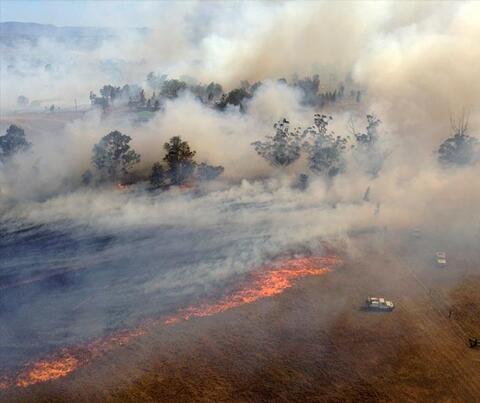
South-eastern Australia is one of the most bushfire-prone areas in the world. While bushfire risk cannot be eliminated, effective planning and management helps reduce its impact on people, property and the environment.
The NSW National Parks and Wildlife Service (NPWS) is responsible for managing fire across national parks and reserves, including in remote and rugged landscapes as well as parks close to communities.
We manage bushfire risk through:
- fire management planning
- preparation and hazard reduction
- responding to bushfires.
We work closely with partner agencies, including the NSW Rural Fire Service (RFS), NSW Fire and Rescue and the Forestry Corporation of NSW, and with local communities to improve preparedness and resilience.
Our fire management approach is guided by the following framework:
- NPWS Fire management direction statement sets our long-term approach to managing fire in national parks
- NPWS Fire management manual provides detailed policies and procedures for fire management.
- Fire management strategies are used in NPWS fire management planning and operations.
Legislation
Under the Rural Fires Act 1997, NPWS is both a firefighting authority and a public authority and is responsible for managing fire on all lands under its control.
NPWS is responsible for taking ‘practicable steps to prevent the occurrence of bushfires on, and to minimise the danger of the spread of bushfires on or from,’ national parks and reserves in New South Wales. As a recognised firefighting authority, NPWS also stands ready to assist other fire authorities in the containment of bushfires across the state.
In accordance with the National Parks and Wildlife Act 1974, NPWS is responsible for protecting and conserving natural and cultural values within national parks and reserves.
Hazard reduction
Hazard reduction lowers the amount of fuel available to burn, helping reduce fire intensity and improve bushfire suppression efforts. In NSW national parks, hazard reduction is carried out through:
- mechanical methods, such as clearing or mowing vegetation
- hazard reduction burns, which are also called planned burns or prescribed burns.
Responding to bushfires
NPWS firefighters are highly trained and equipped to respond to bushfires. Specialist capabilities include remote area firefighting and rapid aerial response:
- Our remote area firefighting teams (RAFT) respond quickly to lightning strikes and other ignitions in remote areas, containing the spread of bushfires.
- During the fire season, rapid aerial response teams (RART) are pre-positioned with aircraft in high-risk locations. Working with the NSW RFS, crews can be winched by helicopter into remote terrain to contain bushfires early.
Staff, partners and resources
Our people
We have more than 1,200 staff with expertise in a variety of specialist fire management roles, including:
- bush firefighting
- fire management planning and hazard reduction operations
- incident control and coordination
- aviation specialists
- state coordination.
Our teams also support firefighting efforts interstate and overseas.
Our partners
NPWS works closely with other fire agencies and the community, including:
- NSW Rural Fire Service
- Fire and Rescue NSW
- Forestry Corporation of NSW
- local bushfire management committees
- neighbouring communities.
NPWS is represented on bushfire management committees across the state, supporting coordinated planning and response.
Our resources and equipment
NPWS uses a range of specialised equipment for fire management, including:
- firefighting vehicles
- aircraft (helicopters and fixed-wing)
- remote sensing technology, monitoring equipment and drones.